
Find your university in the Interdisciplinary Science Rankings 2027
Interdisciplinary scientific research holds the promise of unlocking lessons from multiple academic disciplines to solve global challenges. The Times Higher Education Interdisciplinary Science Rankings (ISR), produced in association with Schmidt Science Fellows, is the first effort of its kind to measure universities’ contributions and commitment to interdisciplinary science.
The ISR methodology consists of three pillars, each representing a stage in the life cycle of research projects: inputs, process and outputs. Each pillar is further divided into metrics to measure different aspects of that stage. There are 11 metrics in total.
In 2025, in response to university engagement and feedback, the interdisciplinary scope was broadened to cover any research project that comprises multiple scientific disciplines, or one or more scientific disciplines combined with one or more of the following non-STEM disciplines: social sciences, education, psychology, law, economics, or clinical and health.
Discover how universities are ranked, the indicators that are used, and why the THE Interdisciplinary Science Rankings is a trusted benchmark for global university performance on interdisciplinary science.
Download the full methodology as a PDF at the bottom of this page.
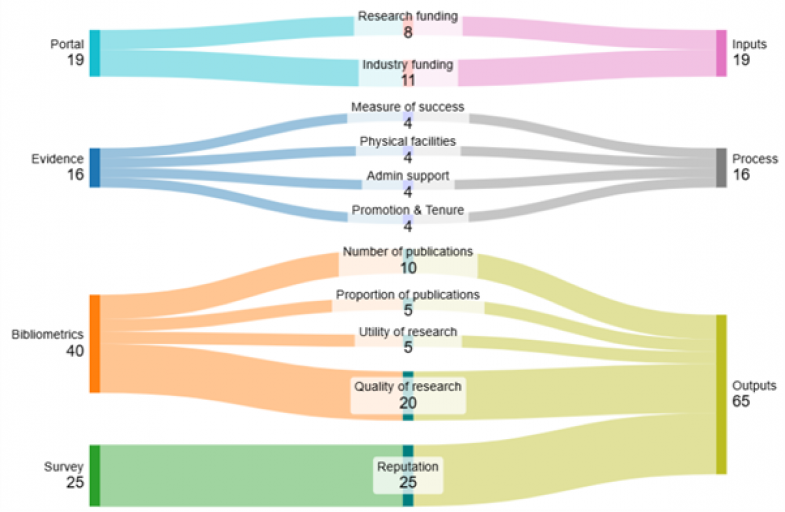
Key criteria for the Interdisciplinary Science Rankings
Three core pillars of evaluation
- Inputs
- Process
- Outputs
How are the Interdisciplinary Science Rankings calculated?
Metrics included
Inputs: 19%
- Interdisciplinary science research funding: 8%
- Industry funding: 11%
The first metric is defined as the proportion of research income in science subjects and clinical and health subjects devoted to interdisciplinary science research. The second metric is the amount of industry funding for science, normalised by the number of academic and research staff members in science.
Process: 16%
- Measure of success: 4%
- Physical facilities: 4%
- Admin support: 4%
- Promotion and tenure: 4%
The metrics in this pillar ask universities to provide evidence. We give credit for the evidence, and for the evidence being specific and publicly accessible.
We examine whether a university has measures of interdisciplinary success, provides specific physical facilities for interdisciplinary teams, provides specific administrative support for interdisciplinary teams, and has a tenure or promotion system in place that recognises interdisciplinary research.
Outputs: 65%
- Number of interdisciplinary science research publications: 10%
- Proportion of interdisciplinary science research publications: 5%
- Utility outside discipline: 5%
- Quality of interdisciplinary science research: 20%
- Reputation: 25%
The first two metrics are based on the number of interdisciplinary science research publications but the first metric is normalised by the total number of academic and research staff in scientific disciplines, while the second is normalised by the total number of scientific publications.
The following two metrics examine citations of interdisciplinary science research. The third metric is a measure of how interdisciplinary a publication’s citations are. To determine this, we examine the relationship between any two publications where one cites the other. To gauge the cross-disciplinary influence of an entire institution, we calculate a score based on all science publications associated with that institution. This gives a sense of the institution’s overall interdisciplinary impact through its research citations.
The fourth metric uses the 75th percentile of field-weighted citation impact for interdisciplinary science research publications – a robust guide to how strong typical research is.
The final metric examines a university’s reputation for support for interdisciplinary teams, based on a survey of active researchers. The respondents were asked to name up to five institutions that are the best globally in terms of interdisciplinary science research.
Producing the overall ranking
Data sources
The first data set used is collected directly from universities and institutions using our data collection system. This data is submitted by approved and authorised representatives of the institution and is validated by THE.
Portal data for the ISR 2027 was collected at the same time as the data for the World University Rankings 2027. Universities were asked to submit data from the financial year, calendar year or academic year that ended in 2024.
The data collected can be classified as either quantitative data or evidence data.
We also draw on bibliometric data. This year, our bibliometric data supplier Elsevier provided 188.7 million citations to 19.9 million journal articles, article reviews, conference proceedings, books and book chapters published over five years. The data includes more than 29,100 active peer-reviewed journals indexed by Elsevier’s Scopus database and all indexed publications between 2021 and 2025. Citations to these publications made in the six years from 2021 to 2026 are also collected.
The survey of active researchers for the reputation metric was conducted in 2026. Universities that signed up to participate in the WUR/ISR data collection were asked to distribute the survey to their researchers. The questionnaire targeted scientists working in science disciplines (defined as physical sciences, life sciences, engineering and computer science) as well as those working on interdisciplinary research involving a science discipline and the social sciences, education, psychology, law, economics, or clinical and health.
To ensure that the result was globally representative, self-votes were discarded and the remaining votes were country-weighted against a benchmark.
Additional survey responses collected through THE’s Global Academic Reputation Survey were used to supplement institutions that were not represented in the ISR survey response set, broadening coverage and representation.
Purchasing power parity rates and currency exchange rates were sourced from the World Bank and HMRC respectively. Data from the year 2024 was used in the ranking calculation.
Definitions
For the ISR 2027, we are using the following definition of interdisciplinary science.
Interdisciplinary science refers to the integration of the knowledge, traditions and processes from multiple scientific disciplines, or one or more scientific disciplines combined with one or more of a select group of non-STEM disciplines. It can involve multiple academics who collaborate with one another across different disciplines. It could also be a single academic approaching a scientific question across multiple disciplines.
Science disciplines are defined as those that fit within the THE high-level subjects of computer science, engineering, life sciences and physical sciences. The non-STEM disciplines included are: social sciences, education, psychology, law, economics, and clinical and health.
If a research project involves two or more science disciplines, or one or more scientific disciplines combined with one or more of the above group of non-STEM disciplines, it is considered interdisciplinary science.
If research includes two topics that fall under only one of the four applicable science subjects mentioned above but they belong to two different subjects in THE’s more detailed 31-subject breakdown, it is considered interdisciplinary.
Inclusion criteria
For an institution to be ranked in the Interdisciplinary Science Rankings, it must satisfy all the following criteria:
- Must submit data for the World University Rankings 2027.
- Must declare at least one science subject (computer science, engineering, life sciences and physical sciences) as applicable.
- Must publish at least 100 interdisciplinary science research academic publications within the five-year window 2021 to 2025.
- Must have at least 50 academic and research staff in total across the applicable science subjects. These staff members do not necessarily need to be engaged in interdisciplinary research.
- Must not have more than two missing metrics, once the metrics have been calculated for the rankings.
- Must not be in THE’s custom exclusion list. THE reserves the right to exclude any institution from our rankings, even if they satisfy all other inclusion criteria.
Universities that submitted data but did not meet the eligibility criteria for our table are included as reporter institutions. This means that they are listed, alphabetically, at the end of the rankings table and, rather than being assigned a rank number, they are instead labelled “reporter” institutions.
Understanding the results
Banded institutions
Precise overall scores are shown for the institutions ranked in the top 200 overall. Banded overall scores are presented for the institutions ranked in bands (for example, from 201 to 250). Precise individual pillar scores are displayed for each ranked institution.
For the institutions ranked 1-200 overall, an individual rank position is listed. The next institutions are assigned to the following bands: 201-250, 251-300, 301-350, 351-400, 401-500, 501-600, 601-800, 801-1,000, 1,001+.
How the Interdisciplinary Science Rankings support decision-making
For students and academics
- Identify the world’s top universities for interdisciplinary science research
- Understand the focus areas of each institution
For universities
- Benchmark performance against global standards
- Highlight strengths to attract international students and partnerships
- Provide critical insights on innovative practice and strategy from globally leading institutions

Register to continue
Why register?
- Registration is free and only takes a moment
- Once registered, you can read 3 articles a month
- Sign up for our newsletter
Subscribe
Or subscribe for unlimited access to:
- Unlimited access to news, views, insights & reviews
- Digital editions
- Digital access to THE’s university and college rankings analysis
Already registered or a current subscriber?