Thousands of New Zealand academics are striking for better pay and conditions, as industrial negotiations and a cost-of-living crisis dovetail with a looming general election.
The Tertiary Education Union (TEU) says the half-day strike on 21 October will involve about 8,000 members at institutions currently engaged in collective agreement bargaining, in the first coordinated stop-work action by staff at universities and polytechnics.
TEU secretary Amy Ross said pay increases offered by universities did not keep pace with the rising cost of living. “Employers are not taking the action required to make jobs sustainable – especially [around] security of employment,” she said. “You cannot build excellent teaching and research on insecure, overstretched staff.”
The union wants contestants in the forthcoming election to commit to a comprehensive long-term investment plan for tertiary education. “We expect political parties to show meaningful leadership and commit to improved funding for the whole sector,” Ross said.
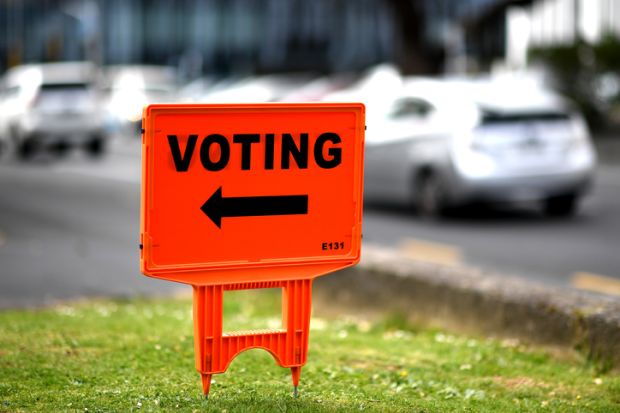
With the 7 November election just over a fortnight away, many parties are yet to unveil their education policies. An exception is Opportunity, a 10-year-old centrist party that could hold the balance of power under New Zealand’s “mixed member proportional” electoral system if it secures 5 per cent of the party vote. Just over 5 per cent of respondents backed it in a recent opinion poll.
Opportunity says that if it wins seats it will work across parliament to establish a 10-year plan for education, along with health. “New Zealand has the people and the capability to build excellent health and education systems,” party leader Qiulae Wong said. “Our job is to give them a clear direction, back them properly and stick with it long enough.”
Opportunity candidate Ben Wylie-van Eerd said the party’s policies also included outlaying an extra NZ$400 million (£169 million) a year to raise government R&D spending to 0.6 per cent of GDP. Much of the money would flow into tertiary education through “new baseline funding” and increased contestable funding.
Wylie-van Eerd, an experimental physicist at Victoria University of Wellington, told a recent TEU election forum that the extra money would help create “stable pathways” for junior researchers facing “volatile” career paths. “I am one of those people who’s doing work in the tertiary education sector on a fixed-term contract,” he told the forum. “It sucks, man.”
The Green Party has vowed to ensure “reliable” research funding above the OECD average, as a proportion of GDP, with improved “equity, diversity and participation” in research and a better understanding of “how stigmatisation, bias and colonisation limit research outcomes”.
The party has also pledged to overhaul tertiary education funding to ensure “a wide range of course options, quality teaching, comprehensive student services, decent pay and conditions for staff and full participation of disabled students”. Other promises include a universal student income, default student union membership and “work towards” fee-free tertiary education and a student debt “write-off”.
The opposition Labour Party has promised a 10 per cent cut to student loan balances, in an adaptation of a policy that underpinned the Australian Labor Party’s successful 2025 campaign. Labour education spokesman Shanan Halbert has also committed to “sustainable” tertiary education funding, including reinstated grant eligibility for humanities and social science research.
Halbert also promised to revive the higher education funding review his party announced when it was last in power. “We need to complete the review so we have the full picture there, and then make some decisions based on that,” he told the TEU election forum.
The National Party, the senior member of the governing coalition, did not participate in the forum. However, prime minister Christopher Luxon has committed to reducing the student loan repayment rate from 12 to 10 per cent if his party retains power.
Luxon also foreshadowed “stronger arrest and enforcement powers” against Kiwi expatriates who failed to repay their student loans.
Register to continue
Why register?
- Registration is free and only takes a moment
- Once registered, you can read 3 articles a month
- Sign up for our newsletter
Subscribe
Or subscribe for unlimited access to:
- Unlimited access to news, views, insights & reviews
- Digital editions
- Digital access to THE’s university and college rankings analysis
Already registered or a current subscriber?