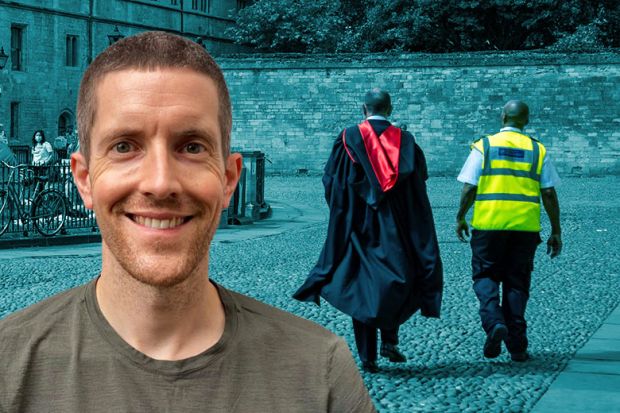
As George Bass pulled a lecturer from her overturned car, his phone began buzzing with a call from an unknown number. It was a BBC producer asking if he was free for interview that day.
The bizarre circumstances of that media request give some clue about the unusual double life lived by Bass, a security guard at a UK university, since his move into journalism in his early 40s. Having pitched a piece to the Financial Times about living on below-average wages in modern Britain in 2022, Bass has since combined 12-hour shifts on campus with writing for The Guardian, The New York Times, The Washington Post and Times Higher Education, among others.
His first-hand accounts of the challenges of existing on £10.71 an hour struck a chord with readers during the cost-of-living crisis and Bass was frequently in demand for interviews. But his humorous dispatches from campus have also proved a hit, leading to his first book, What the Bouncer Saw, set to be published on 7 May by Corsair, the literary imprint of Little, Brown Book Group (Hachette in the UK) where he joins a star-studded roster of authors including James Patterson, J.K. Rowling (as Robert Galbraith) and Stephanie Meyer.
Bass initially turned down the chance to write a book after he was asked to take six months off to travel the UK investigating the difficulties faced by hourly-paid service industry staff. “They wanted me to take a six-month sabbatical and speak to people in similar situations to me,” recalled Bass, speaking to THE. “In my line of work, you don’t get sabbaticals – six days off and there is an investigation,” he added.
“With the hours that I work – four days on, four days off – I already miss a lot of weekends, birthdays and family events as it is, so I wasn’t prepared to be away from home even longer,” continued Bass.
“But I mentioned it to my dad who told me how many publishers J.K. Rowling sent her manuscript to before she got a bite, and I was turning down a commission. I didn’t want to go around asking people about the indignities they’d faced but didn’t mind detailing my own, so I pitched something different,” he said.
Bass’ book is part-memoir, detailing his life growing up in a working-class household in Kent before, after a brief stint at university, moving into labouring jobs then security work, but it mainly centres on his life as a university security guard. The tone is mostly comic, but his campus diary sets out the tricky task of supervising thousands of students living away from home for the first time, who are often anxious and stressed, sometimes hedonistic or unruly and occasionally abusive and self-destructive.
“University can be a tough time as students often feel very dislocated. During the 9 to 5, there are lecturers, professional service staff and student union officers to help out but, outside these times when problems usually occur, it falls to us, the security staff, to sort things out,” reflected Bass.
Peppered with anecdotes of student life, What the Bouncer Saw tends to see the funny side of student struggles. Stories of students drunk in class, inept drug dealers and final-year undergraduates having essay deadline meltdowns nonetheless highlight the multifaceted and usually thankless role performed by security. In short, they must uphold campus safety when events threaten to turn nasty, but also act as an unofficial counsellors and confidants for students who seem determined, in some cases, to make bad choices.
In one incident, Bass is asked to help a student whose flat was reportedly invaded by masked burglars. The burglars, she claimed, forced her flatmate to transfer £1,800 out of their account, before making off with her Louis Vuitton handbag. With a police check revealing an almost identical robbery on rent deadline day the previous month, Bass gently advised her to drop the complaint.
“Students are legally adults and have a lot of freedom but they often aren’t ready to handle the responsibility of being an adult,” said Bass.
“There is as much anxiety as there is debauchery and actually the ones enjoying themselves are those who don’t worry about so much,” he continued, noting how he is often called upon to reassure students having late-night crises on the eve of coursework deadlines, or even helping those who self-harm.
“I’m cursed with a very good memory, so I can remember everything I did as an 18-year-old so I can talk about what I did at that age. I don’t judge anyone and usually talk about how these crises are pretty common,” he said on how he defuses emotional situations.
“I won’t tell people what to do but I’ll explain that life is like a big boomerang. You can chuck it as hard as you like but it will come back and hit you – if you want to drink 20 Jägers in an evening you’ll feel it the next morning,” said Bass.
Increasingly, he is also required to deal with worried parents as well as troubled teenagers. “Parents will ring us at 4 or 5 in the morning, saying they can’t get hold of their son or daughter, and they want to know if they’re all right. We have to explain they’re adults and we can’t provide running updates on them but we’ll give them a few door knocks and ask them to contact mum or dad,” he explained, noting how “some students are there mainly because it’s the quickest way to get a space of their own”.
Treading the right line between pastoral care and surveillance is a tricky one, said Bass. “If we’re concerned about a student, we might go round to a door lock check if you suspect someone hasn’t been out of their room in a while. Then you can have a chat and see if they’re OK,” he said, noting that cleaners are a useful source of information on at-risk students.
“It’s not about creating an atmosphere of surveillance but we also don’t want students to put themselves in danger without them realising it,” he said.
Bass is keen to stress that his own foibles and missteps are far more prominent in What the Bouncer Saw than anything on the carefully anonymised campus incidents he details. “I don’t want to shame or embarrass anyone – lots more stories have been left out that I could have included.”
“I used to tell my friends about these things, like the time I pulled someone out of a hedge, and it turned out they had a master’s in theology. I’ve thought there might be an appetite for these stories – all of which are 100 per cent true – and that seems to be the case.”
Register to continue
Why register?
- Registration is free and only takes a moment
- Once registered, you can read 3 articles a month
- Sign up for our newsletter
Subscribe
Or subscribe for unlimited access to:
- Unlimited access to news, views, insights & reviews
- Digital editions
- Digital access to THE’s university and college rankings analysis
Already registered or a current subscriber?