Introducing the Advisory Board for the International Green Skills Accreditation Framework
In support of the United Nation’s Green Jobs for Youth Pact, Times Higher Education (THE) announced the formation of an International Green Learning and Skills Advisory Board at the Global Sustainable Development Congress earlier this year in Istanbul. The Advisory Board comprises members from across the higher education and non-governmental sectors, bringing the sector’s most engaged and creative contributors in sustainability education together.

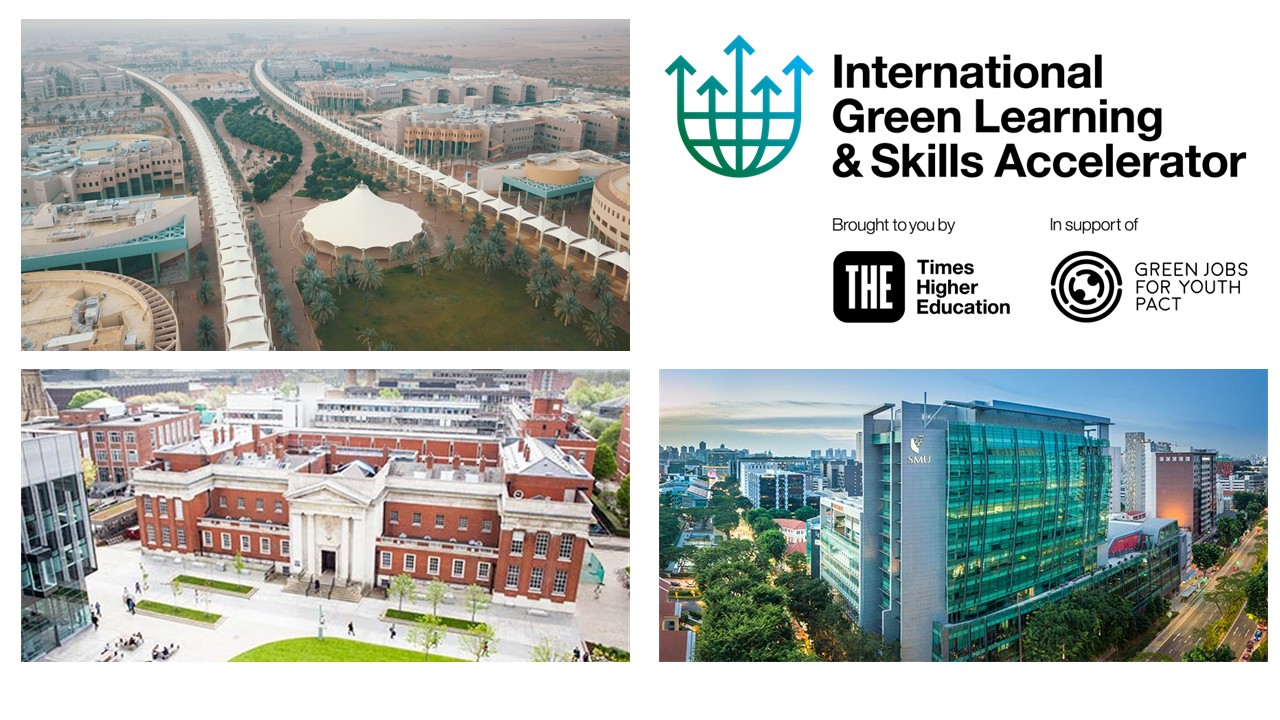
About
In support of the United Nation’s Green Jobs for Youth Pact, Times Higher Education (THE) announced the formation of an International Green Learning and Skills Advisory Board at the Global Sustainable Development Congress earlier this year in Istanbul. The Advisory Board comprises members from across the higher education and non-governmental sectors, bringing the sector’s most engaged and creative contributors in sustainability education together.
This Board will play a pivotal role in shaping the THE International Green Skills Accreditation Framework, developed to capture the education and skills required for sustainability, that are applicable across different geographies.
Through consultation with the Board, THE will aim to evaluate the contributions of universities to sustainability education, and establish a set of standards that can drive curriculum transformation, scale sustainability literacy, and promote an emerging green workforce.
Meet the Advisory Board members
The Board will guide the development of this framework through collaborative consultation, shared expertise, and a commitment to sustainability. We are pleased to welcome our university partners, as well as individual advisors from across the globe, each bringing unique perspectives shaped by the respective geographic challenges in sustainability to the table.
Below, our advisory board members share their backgrounds, perspectives, and vision for the future of green skills development.
Official partners
Founding partner: Prince Sattam Bin Abdulaziz University
Professor Abdullah M.Elias
At Prince Sattam Bin Abdulaziz University (PSAU), we believe that education must empower individuals to shape a more sustainable and just world. Anchored in our 2030 Strategic Plan and Sustainable Development Goals (SDGs) Roadmap, our approach to green skills development is integrated, strategic, and student-focused. Sustainability is embedded in our curriculum, operations, and community engagement—aligned with Saudi Vision 2030 and global SDG frameworks.
PSAU’s strategic approach encompasses several pillars. Beyond curriculum enhancement and awareness campaigns, we prioritise industry partnerships to ensure real-world alignment of green competencies with labour market needs. We actively engage students in interdisciplinary projects, sustainability-focused hackathons, and experiential coursework that build capabilities in renewable energy, waste management, circular economy, and environmental engineering.
Our decision to become a founding partner of the International Green Learning and Skills Initiative reflects our commitment to shaping global green education standards. We view this initiative not only as a platform for collaboration but as an opportunity to amplify the voice of institutions, ensuring equity in shaping the future of work and learning.
Looking ahead, PSAU envisions a future in which green skills are not a separate theme but an intrinsic part of all disciplines. We are investing in international student and faculty exchange programmes to promote global knowledge-sharing and green research. Our PSAU Global South Partnership is one example that provides a unique vehicle for co-creating solutions with partner institutions across Africa, Asia, and Latin America on issues like climate resilience and justice, renewable energy, sustainable agriculture, and low-carbon economies.
PSAU stands out for its deep integration of the SDGs into student life, from project-based learning and research to green infrastructure, service-learning and campus sustainability initiatives. Our institutional pillars —student-centricity, sustainability, partnerships, and a strong emphasis on STEM and medicine education—ensure that our graduates emerge as globally conscious, action-oriented leaders.
In sum, PSAU’s mission in the Green Skills and Learning Initiative is clear: to lead by example, collaborate boldly, and prepare the next generation of sustainability leaders for communities across the world.
Singapore Management University
Associate Professor Terry Van Gevelt
Singapore Management University (SMU) is committed to fostering green skills across Southeast Asia, and we see the International Green Learning and Skills Accelerator as a crucial platform to contribute our regional expertise to. We aim to provide insight into how universities can embed green skills into their curriculum and institutional culture and collaborate with global partners to co-develop a first-of-its-kind accreditation framework.
In Southeast Asia, universities face the challenge of responding to climate risks within economies that are still transitioning. With many countries lacking clear strategies for green skills, there is an opportunity for universities to act as 'system-builders,' helping to shape the very definition of green jobs and design future-oriented learning pathways.
At SMU, we embed sustainability into both our undergraduate and postgraduate education, from mandating sustainability topics in our core curriculum to offering an interdisciplinary Master of Sustainability programme. Our work goes beyond the classroom, with more than 30 student projects and nearly 40% of startups from our Business Innovations Generator (BIG) programme focused on tackling sustainability challenges. This showcases how our students are translating academic insight into real-world solutions. Additionally, through professional courses and a free Massive Open Online Courses (MOOC) in sustainable finance and climate change—which has been further translated to Bahasa Indonesia, Thai, and Vietnamese—, we are democratising access to sustainability knowledge across the region.
Our comprehensive approach prepares our graduates to lead and innovate in a world where green competencies are no longer optional, but essential, to actively shape the future of green economies.
Professor Jennifer O’Brien
Close your eyes. Imagine your world in 20 years-time. Hopefully it is a world in which you, your friends, family, and communities near and far, are flourishing. Green skills are essential to achieve that vision. But what are green skills? I wish I had a coin for every time I have been asked that question! At their heart, green skills are about equipping ourselves with the ability to create a world that is fairer, greener and healthier, for all people and species.
A green skills approach involves critically interrogating assumptions about the world and understanding interlinked systemic drivers of socio-ecological destruction. A green skills approach offers co-constructed, experiential, interdisciplinary, and flexible learning that brings together heads, hearts and minds. Such an approach can be challenging – applied interdisciplinary teaching is easier said than done - but it is also joyous and transformative for teachers and learners, individuals and organisations alike. Learning green skills must start as early as possible, so the green can become deeper and darker across a more flexible life-long learning approach that enables imagination and criticality. A green skills approach transcends ‘greenie’ specialisms and enables every job to become a green job as we embrace collective power, whilst recognising individual uniqueness to change the world for the better.
As a proudly Civic University with Social Responsibility as our third goal sitting equally alongside research and teaching, the University of Manchester makes a difference. We are fully committed to helping realise the Sustainable Development Goals, and have consistently ranked in the top five of the Times Higher Education Impact awards. We harness our 46,000 strong student body as a force for change through our University Living Lab, which allows students to develop green skills by doing coursework that supports the needs of communities, industry, business, and schools. Our University-wide Sustainable Futures platform brings disciplines together in teaching, research and innovation to enable systemic, inclusive and just approaches to facilitate nimble workforces and respectful human beings, who are equipped with the skills to construct our sustainable world.
We cannot continue with business as usual. Green skills can create a sustainability transformation from within society, by enabling students to develop collaborative, joined-up approaches to the world that simultaneously enhance their own success and the sustainability of our planet. As University educators, the lever of change at our fingertips is colossal, and the moment is now.
Individual Advisors
Jean-Christophe Carteron, Co-Founder of Sulitest
What drives us at Sulitest is the belief that systemic change will not come simply because some people learn and enter into new professions (the so-called "green jobs"). For us, it requires a massive effort to revisit all academic programs and examine how conventional professions must evolve so that all graduates are equipped to make informed and ethical decisions and engage in responsible action. It is through widespread adoption of assessment tools like TASKTM that we will achieve our goals.
For a person to be capable of taking responsible action, they need:
- A well-defined foundation of shared knowledge (what we call the "Common Language" at Sulitest, measured through our TASK™ assessment instrument). They also need knowledge related to their profession, sector, and broader environment.
- They must also develop skills—some of which are universal (such as those found in UNESCO frameworks or the European Green Comp models) and others that are specific to their field.
- Finally, they need the appropriate mindset—an outlook and values that show care for the planet and the many lifeforms upon it.
What is interesting when examining existing green competency frameworks is how much convergence they reveal, as highlighted during the Higher Education Sustainability Initiative (HESI) workshop in Istanbu):
- The Center for Curriculum Redesign’s Four-Dimensional (4D) Competencies Framework emphasises creativity, critical thinking, courage, resilience, and ethics.
- The Inner Development Goals focus on critical thinking, complexity awareness, perspective skills, sense-making, long-term orientation, and visioning.
- UNESCO and European GreenComp include critical thinking, systems thinking, analysing complex systems, envisioning the future, and empathy.
Of course, these four frameworks have their differences, but they all help program directors define learning goals. More specialized frameworks, such as the one developed in France by the Conférence des Directeurs des Écoles Françaises de Management (CDEFM) (a representative body of all French business schools), go even further by proposing learning objectives at both bachelor’s and master’s levels.
Some frameworks cover the entire institution—such as Sustainability Tracking, Assessment and Rating System (STAR) by the Association for the Advancement of Sustainability in Higher Education (AASHE) in the U.S. or Green Plan in France—and include qualitative and quantitative indicators to measure institutional efforts. When delving deeper into the teaching part of these frameworks, they assess the number of courses, and number of electives, amongst others. Our colleagues at Joineduc also follow a similar approach.
At Sulitest, we have focused our TASK tool on measuring systemic awareness of sustainability challenges. Unlike the frameworks mentioned above, we provide a robust and comparable assessment of students' knowledge levels. By measuring outcomes, we capture the real impact of the actions implemented.
As I mentioned during the workshop in Istanbul, numerous projects have led to the creation of competence frameworks. However, limited awareness and adoption of these tools have posed challenges to the practical implementation of pedagogical practices and curriculum changes needed to develop these competencies. Personally, I hope that our project will enable us to identify the triggers and levers that will bring about systemic change.
Darren Axe, Membership & Engagement Manager, Students Organising for Sustainability International (SOS-International)
At SOS-International, we are committed to putting the sustainability priorities of students at the centre of policy development and decision-making within their own educational institutions and beyond. We work as a global network of student and youth organizations, promoting best practices and advocating for systems change.
In 2024, we conducted research across five global regions, reaching over 1,000 young people, leading to the publication of the Green Skills and Green Jobs Youth Consultation. This work, funded by the United Nations Environment Programme (UNEP) under the Green Jobs for Youth Pact, co-created green skills definitions and competencies with students, and set out emergent calls to action for educators, employers and policymakers. The report also identifies regionally specific priorities for the five regions involved: Europe, North America, South America, Africa, Asia.
Our motivation for joining the International Green Skills Initiative advisory board is to continue to collaborate with organisations and institutions leading on embedding sustainability into their core function, and to ensure that students are involved in defining and delivering this systemic reorientation.
Our vision is a higher education landscape that embeds globally defined but locally relevant competencies for a safe, just and regenerative future across all curricula. Further to this, we see Universities providing a space where students co-create solutions to complex problems through forging creative learning coalitions across their local network of faculty, operational staff, management and wider community.
Ghazala Syed, Higher Education Advisor, GMS Strategies
I lead GMS Strategies, advising governments, multilaterals, and education leaders on transforming higher education and skills systems to be climate-responsive, equitable, and future-ready. My work builds on my tenure at USAID, where I advanced higher education, skills, and employability initiatives aligned with the USAID Climate Strategy 2022-2030 and the Sustainable Development Goals especially SDG 4 (Quality Education), SDG 8 (Decent Work), SDG 13 (Climate Action), and SDG 17 (Partnerships). In that role, universities became platforms to deliver climate action, create pathways to green jobs, and strengthen community resilience.
I have worked across Africa, Latin America, and Southeast Asia, drawing on local research, practices, and insights from institutions, employers, and youth networks shaping green transitions in their communities. In Africa, I convened higher education leaders to align agricultural science programmes with climate resilience and food security priorities. In coastal Latin America, I helped universities build partnership capacity with local governments and the private sector to enhance engineering education with nature-based flood control. In the Philippines, I supported universities in launching climate ventures that linked entrepreneurship to community development through green training.
These successes show what’s possible, yet challenges persist: incomplete labour market data, under-resourced career services, and youth networks lacking sustained funding and platforms. On this Advisory Board, I aim to bridge policy and practice, ensuring locally led solutions inform global standards and that employability, equity, and resilience remain central to green learning.
I see the International Green Skills Accreditation Framework as a coalition-building platform — elevating the Global South’s voice, connecting campuses with communities, and preparing the next generation to thrive in a just, climate-resilient economy.