Universities do not exist outside society. Nor should they aspire to. But neither should they be required to declare positions on matters of extraordinary complexity or endorse statements that offer little room for nuance.
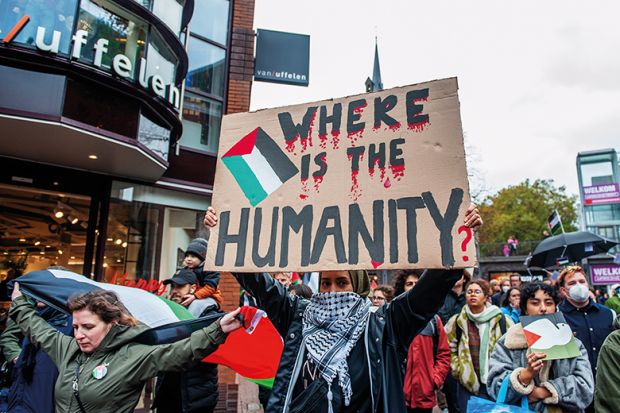
In recent years, however, universities have been pressed by students, staff, unions or internal groups to adopt clear positions on Black Lives Matter, MeToo, Israel-Palestine or debates about sex and gender. On more than one occasion, senior colleagues and I have faced murals and banners depicting our names dripping in blood when we have refused to comply.
The demand is often binary: are you for us or against us? Silence becomes complicity. Qualification becomes betrayal. Even dialogue can be characterised as normalisation.
For university leaders, the consequences of navigating these questions badly can be substantial. Complaints, litigation, regulatory scrutiny, reputational damage and social media campaigns can follow decisions in either direction. There are also serious consequences for individuals when institutions fail to uphold their responsibilities or get the balance between competing rights wrong.
These are real responsibilities, not simply reputational risks. But they can produce two equally unhelpful institutional responses: precipitous action intended to demonstrate that something is being done, or paralysis in which difficult decisions are endlessly deferred.
Neither is an adequate substitute for confident, intellectually grounded leadership.
More fundamentally, in seeking to manage controversy, institutions can inadvertently surrender their intellectual authority. We become reactive, responding to whichever demands are most immediate or forcefully expressed rather than drawing confidently on our own knowledge and methods.
I have experienced these tensions directly as a senior university leader responsible for culture and belonging at Goldsmiths, University of London, an institution with activism in its bones. From its origins in bringing skills and critical thinking to working-class communities in south-east London, through the Battle of Lewisham and the New Cross Fire, to contemporary movements for social justice, activism is inseparable from our institutional history.
That is something to celebrate. But it also presents difficult questions about the relationship between activism, scholarship and institutional responsibility.
Our experience of navigating contested questions of inclusion and freedom of expression has illustrated these challenges. Institutional efforts to improve student support, conduct, curriculum, training and dialogue can themselves become the focus of intense disagreement.
Some practical actions were relatively straightforward. Others became sites of intense contestation, with competing claims about inclusion, academic freedom, freedom of speech and institutional legitimacy. Attempts to establish expectations of conduct could themselves be interpreted as restrictions on expression. Efforts to facilitate dialogue could provoke opposition to dialogue taking place at all.
The lesson is not that universities should avoid difficult issues. Quite the reverse. It is that we need a much more intellectually confident account of what our contribution should be.
Universities are not campaigning organisations, although their members may campaign. Nor are they courts, although we have legal obligations that must be discharged. And we are not simply neutral spaces in which anything goes.
Our distinctive contribution is the disciplined examination of ideas. We ask what the evidence shows, which assumptions are being made, what alternative interpretations exist and what remains unknown. We create knowledge through argument, enquiry, creativity and challenge.
This does not mean treating every proposition as equally valid. Nor does it mean retreating into false neutrality about evidence, discrimination or the law. Universities must act decisively where rights are breached or people are threatened. But institutional legitimacy should rest on scholarly enquiry rather than ideological certainty.
I want to propose a different model: academic activism.
By this I do not mean academics campaigning for their preferred causes, nor an institutional endorsement of particular political positions. I mean something more distinctive: the deliberate mobilisation of academic knowledge, methods and critical capacities to engage with the most contested questions facing society.
Academic activism begins not with a declaration of what we believe, but rather with the questions we know how to ask. What is the evidence? What assumptions underpin competing claims? What can different disciplines contribute? What don’t we know?
This also means recognising when emotion is being presented as analysis. Deeply felt convictions deserve to be heard, and emotion can be an important source of insight. But intensity of feeling should not be mistaken for fact or present as a substitute for evidence. Likewise, moral certainty does not become an academic argument simply because it is expressed in academic language.
Its ambition is not to eliminate disagreement, but rather to make disagreement intellectually productive.
That requires distinguishing protest from dialogue. Both are legitimate, but they do different things.
Protest seeks change. Dialogue creates opportunities to interrogate competing perspectives, test assumptions and encounter complexity. Its purpose is not necessarily consensus, or even mutual understanding. It is the possibility of intellectual engagement across difference.
And dialogue cannot simply be wished into existence. It requires structures, skills and conditions of safety. When intimidation, harassment or violence prevent others from participating, institutions must intervene. Masked protesters hammered at doors and windows for more than an hour at one dialogue event. Freedom of expression is not sustained by allowing the loudest voices to silence everybody else.
Intimidation is not always overt. It can be masked as protest, solidarity or the protection of others, while creating an atmosphere in which some people conclude that speaking is simply not worth the consequences. Universities must be alert to that distinction: protecting vigorous dissent without allowing the language of inclusion or justice to become a means of silencing disagreement.
What would academic activism look like in practice?
First, universities should proactively mobilise their intellectual resources. Rather than waiting for the next controversy and struggling to formulate an institutional position, we should anticipate emerging conflicts, connect them to our research and teaching expertise, and convene academically led, evidence-informed engagement.
Second, we should embed the skills of dialogue, critical engagement and conflict resolution in our curricula. We teach students to evaluate evidence and construct arguments. We should be equally ambitious about equipping them to disagree constructively, recognise complexity and revise their positions without experiencing intellectual change as political defeat.
Third, we need to strengthen the capacity and judgement of institutional leaders. Too often, difficult issues are dispatched to human resources, equality teams or other specialists, as though conflict and disagreement can be outsourced. They cannot.
Finally, universities need to recover intellectual humility. In an environment increasingly organised around certainty, perhaps our most radical contribution is to demonstrate that nobody has a monopoly on insight.
Indeed, our intellectual confidence should come precisely from that humility: the recognition that my view has no greater claim to authority simply because it is mine, any more than yours does because it is yours. What matters is how our respective claims withstand evidence, scrutiny and challenge. That is not intellectual weakness. It is the foundation of academic authority.
We should be places where people can change their minds, where disagreement is not automatically deemed hostility, and where complexity is understood as an invitation to enquiry rather than a failure of conviction.
And we should be places where any view on any subject can be heard, within the law, and subjected to rigorous intellectual examination. That does not require endorsement, agreement or protection from criticism.
None of this is easy. Courts struggle with some of these questions, and adjudication is their purpose. Universities, with their overlapping responsibilities to students, staff, scholarship and society, can hardly expect simple answers.
But that is precisely why our response must be rooted in what universities uniquely know how to do. The choice is not between activism and neutrality, or between free speech and inclusion. It is whether universities will remain reactive arenas for increasingly polarised disputes, or become active intellectual contributors to their resolution.
Adam Dinham is professor of faith and public policy at Goldsmiths, University of London, where he is pro vice-chancellor and executive dean (culture and belonging).
Register to continue
Why register?
- Registration is free and only takes a moment
- Once registered, you can read 3 articles a month
- Sign up for our newsletter
Subscribe
Or subscribe for unlimited access to:
- Unlimited access to news, views, insights & reviews
- Digital editions
- Digital access to THE’s university and college rankings analysis
Already registered or a current subscriber?