How to prepare our students for the skills economy
Our students will be job-hunting in a skills-based economy – and the skills employers will most value are not necessarily the ones you'd expect

Yein Oh







Have you heard of the term “knowledge economy”? Coined by management-theory educator Peter Drucker, it describes an economic system where the production of goods and services is based principally on knowledge-intensive activities that contribute to advancement in technical and scientific innovation.
We heralded the knowledge economy in the last decades of the 20th century. But now, in 2025, the conversation has shifted. Rather, we talk about the skills economy.
So what is the skills economy? It signals a shift in how we think about professional value and success that challenges the significance of traditional credentials and job titles. It essentially places individual skills – the ones we have and need, and our ability to acquire new ones – at the forefront of decision-making.
If you want to read more about skills economy, here are takes by Harvard Business Review, McKinsey, and PwC.
All about skills
First, let’s define what skills mean.
The Joint Research Centre of the EU Commission defines skill as the “ability to apply knowledge and use know-how to complete tasks and solve useful problems, typically in the workplace”.
Or, broadening the context of usage, the World Economic Forum defines it as “the set of process-oriented capabilities that enable an individual to achieve a specific goal”.
Let’s go over some skills-related definitions that may be useful in the job-search process:
Skills gap is the mismatch between the skills employees have and the skills employers need.
Upskilling is the process of learning new skills to close the skills gap and stay competitive.
T-shaped skills refer to the combination of deep expertise in one specific area (the vertical bar of T) and a broad range of skills in related areas (the horizontal area of T).
Research and resources about skills
The World Economic Forum (WEF) is widely known for hosting its prestigious annual Davos meetings. But it also creates interesting and useful resources, including the Global Skills Taxonomy and the Future of Jobs report.
Global Skills Taxonomy
The Global Skills Taxonomy is an extensive system that helps us to categorise and think about skills in a really detailed way.
It's divided into the three levels:
Level 1 is divided into two broad categories: attitudes versus skills; knowledge and abilities.
Level 2 is divided into: cognitive, engagement, ethics, management, physical abilities, self-efficacy, technology, working with others.
Level 3 is broken down into the most specific categories, ranging from dependability to design, user experience, civic responsibility and customer experience.
The interactive tool on the Global Skills Taxonomy website reveals the sheer diversity and breadth of skills out there, beyond those we usually see on CV skills lists.
Future of Jobs report
The WEF released its Future of Jobs report in January 2025. Here, it analysed many career-related trends, one of which was skills.
The WEF presents a matrix that categorises skills according to whether they are important now and whether they will be important in the future:
Out-of-focus skills: less essential now, and not expected to increase in use
Steady skills: core now, but not expected to increase in use
Emerging skills: less essential now, but expected to increase in use
Core skills: core now and expected to increase in importance
And it places more than 25 skills into these four categories on a chart. The results may surprise you.
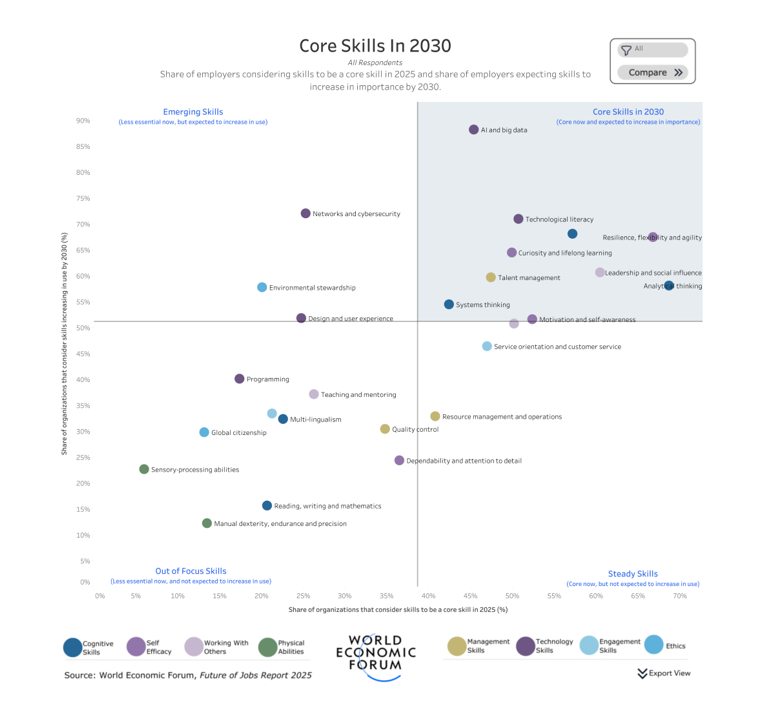
For instance, check out skills such as “programming”, which were much-touted several years back, or the “global citizenship” that’s often encouraged in international-school settings. Knowing that WEF categorises them as out-of-focus skills, how would you approach these now?
Alternatively, you can use emerging skills to identify jobs that may be up and coming in a few years’ time, but are not in the spotlight now (such as “networks and cybersecurity”).
Meanwhile, the core skills in 2030 would be the most useful to focus on, when working with your students. With this visual, you can see which skills to start focusing on more, so as to spend your limited time more productively.
Applying knowledge about skills to our counselling
So what should we do with this as counsellors? On a more holistic level, WEF actually published a blog post about why education should adopt a skills-based approach, which is a good read.
Here are some more practical suggestions about how to incorporate the concept of skills in your counselling curriculum.
Encourage reflection about skills
Our students are encouraged to take part in various extracurricular activities. In essence, through all these activities, they are engaging in skill development. So we can ask them questions to encourage metacognition and reflection on what skills they are gaining.
Help students identify skills they possess
The aforementioned T-shaped skills develop when one identifies a natural talent or strength and nurtures that (which becomes the vertical in the T). If you’ve worked on US applications, this can be analogous to the concept of the application spike. This is a good way to stand out, not only in university admissions, but in later job searches – and you are doing students a service if you help them to identify their strengths.
Teach students how to demonstrate skills
It’s easy to slap a skills section on the CV and list skills that you think look good for the job.
However, the skill of actually evidencing the skills you list also needs to be taught. This can be done through quantifying activities or by telling anecdotes that clearly demonstrate use of the skill.
Teach students and parents important skills-related concepts
After we familiarise ourselves with these concepts, let’s teach our students and parents as well – giving a boost to students’ career development.
Providing a comparison between the knowledge economy and the skills economy may help parents who are still stuck in the mindset of the knowledge economy, and assuming that certain degrees will still guarantee success.
Also, dig into the very extensive Future of Jobs report – it has so much more to offer than the very brief glimpse covered in this article.
For instance, when you’re talking about the skills gap, use infographics such as the following to paint a clear picture of the importance of upskilling.


Encourage lifelong learning
The advent of the skills economy means that lifelong learning is essential. Learning should not be something that stops at university – in fact, “curiosity and lifelong learning” is a core skill now, and one that’s expected to increase in importance.
When you’re telling students to pursue supracurricular activities (learning beyond what’s taught in school), you are encouraging lifelong learning. A popular way to learn is through microcredentials offered by platforms such as Coursera, EdX, and LinkedIn Learning. Credential Value Index is a great website to help students (and adults) choose microcredentials wisely.
Skills in the age of AI
Finally, as AI is transforming the world (in fact, this may be one of the factors that drive the shift from knowledge economy to skills economy, as explained in this Forbes article), it may be helpful to think about what humans can do that AI can’t.
It feels like AI is making unprecedented leaps seemingly every few months; the speed is certainly alarming and may seem discouraging. But let's not get discouraged, and instead continue learning about AI and about what makes us uniquely human. Here are some articles on this topic.
- AI and Automation: the human skills that make the difference
- AI is shifting the workplace skillset. But human skills still count
- How we can elevate uniquely human skills in the age of AI?
Credit to Young Chul Oh for the inspiration for portions of this article.