An overview of the different types of international school
International schools come in different flavours, with different goals and values. Choosing the right one for you is just as important as helping your students find their best-fit university






Before I accidentally fell into school counselling, I worked in student recruitment and admissions. One of the privileges of the job was getting to visit various schools across Asia.
I remember an embarrassing situation when, during a mid-October visit to a large international school in Shanghai, in front of a group of about 20 university representatives, I asked the school counsellor, “So, are you guys gearing up to celebrate Halloween?”
To which the counsellor gave a terse, po-faced reply: “No, sir. We are a Christian school.”
It was at that moment that I learned that international schools come in different flavours. From mission-driven institutions focused on access and equity to profit-oriented enterprises, and from environmentally conscious schools or those built around sport or religion, there is a whole spectrum of schools serving different global communities.
As a prospective school counsellor, the school you choose can greatly influence your experience as an employee. And it can shape the professional and – to some extent – cultural expectations of those working, studying and existing in the system.
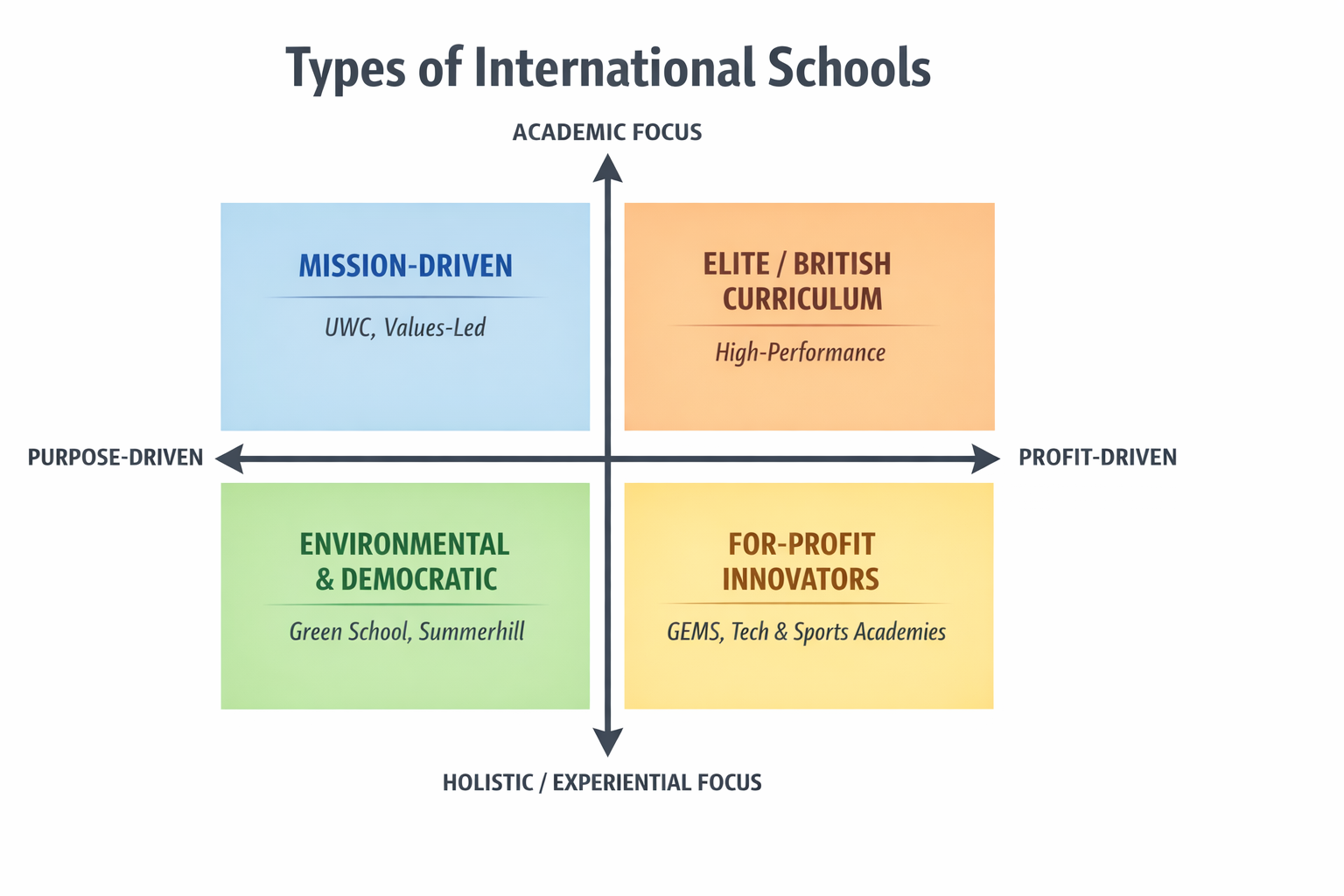
The rubric below gives an overview of the different types of international schools, from purpose-driven to profit-driven, and from academically focused to holistic or experientially focused.
National-curriculum schools
National-curriculum international schools are private, internationally oriented schools that deliver accredited, recognised national education programmes – quite often a British or American curriculum – outside their home country.
For example, schools such as Bromsgrove International School Thailand typically follow the English National Curriculum, leading to IGCSEs and A levels. And institutions like Singapore American School or American School of Dubai deliver an American-style education, culminating in a high-school diploma and, quite often, Advanced Placement courses. Similarly, the Lycée Français network – a global education system primarily managed by the Agency for French Education Abroad – offers French-language instruction and access to the French Baccalauréat in various countries.
These schools are popular with both expatriate and local families, because they combine the structure and academic rigour of a recognised national system with an international environment, strong English (or other) language instruction and well-trodden paths to global universities.
Mission-driven schools
Mission-driven international schools are usually founded with a clear social, educational or humanitarian purpose. Their ethos often centres on equity, access and global citizenship. Many operate as non-profit organisations, reinvesting income into scholarships, teacher development or community outreach.
Examples include the Aga Khan Academies, with schools in the Indian subcontinent and across Africa. These focus on developing ethical homegrown leaders with a pluralistic worldview and a commitment to serving their communities. Meanwhile, the United World College schools and colleges, which include 18 schools across four continents, aim “to make education a force to unite people, nations and cultures for peace and a sustainable future”.
While mission-driven schools may face more financial constraints than their for-profit competitors, their strength lies in coherence of purpose. Working for a mission-driven school can give you a clear sense of belonging and an appreciation of the mission – if it aligns with your personal values. Decisions in these schools are typically guided by institutional values rather than market demand.
For-profit international schools
These schools operate as commercial enterprises, often backed by private equity or education conglomerates. They tend to be operated by large organisations, where expansion (building new campuses around the world), high tuition fees and financial returns to investors are explicit drivers.
For-profit schools typically feature premium facilities, international curricula and strong marketing positioning aimed at expatriate and affluent local families. They also usually offer competitive salary packages.
Examples include the GEMS schools, operating mainly in the Middle East, Nord Anglia Schools, with more than 80 schools worldwide offering a British curriculum, and Cognita Schools, a global private-equity-backed educational group operating more than 100 schools.
These schools may operate under a mission statement (sometimes referred to, in a near-reverential tone, as their “north star”), but ultimately they are driven by the need to make profit. The tension between educational quality and shareholder return remains a defining feature of this model, and this dynamic can influence decision-making at a senior-leadership level.
Sports or athletics schools
Sports-driven international schools integrate athletic excellence into their core identity. These institutions often function as training grounds for elite athletes or as environments where sport and athletics are central to student development. They may offer specialist coaching, partnerships with professional clubs and intensive training schedules alongside academic study.
Examples include Aspire Academy in Qatar, with top-notch football and athletics facilities, including the world’s largest indoor sports dome. IMG Academy in Florida provides specialised coaching in more than 15 sports, and Hochalpines Institut Ftan in Switzerland offers elite training in sports such as skiing and snowboarding.
Faith-based schools
As I discovered to my cost in Shanghai, these schools are founded on faith-based principles and integrate spiritual development into their educational mission. They may be affiliated with specific religious traditions, such as Christianity, Islam, Judaism or Hinduism.
Alongside standard academic curricula, students often engage in religious studies and religious practice. Values tend to be strongly aligned with the institution’s faith tradition. For many families, these schools can provide a sense of cultural continuity and moral grounding in an international context.
Examples include the Yew Chung and Yew Wah International Schools across China, which are grounded in Christian moral teaching and spiritual education. And Greenview Islamic International School in Malaysia combines Cambridge international assessments with Islamic values.
Environmental schools
Faced with the increasing impact of the climate crisis, we are seeing a rise in the number of schools that dedicate their mission and vision to sustainability, regeneration and nurturing the next generation of climate problem-solvers (there is still hope!).
These institutions often embed climate education, ecological literacy and outdoor learning into the curriculum. They are committed to delivering holistic, experiential education with a focus on environmental stewardship, with sustainability as an integrated educational framework (rather than just a tick-box add-on).
Examples include the Green Schools in Bali, New Zealand and South Africa, Del Mar Academy in Costa Rica and The Earth School in the Philippines.
Many environmental schools adopt green-campus initiatives, such as renewable energy use, zero-waste policies, a tangible connection to the natural world and biodiversity projects. Students are frequently involved in real-world environmental action, from conservation work to policy advocacy.
Variety is the spice of school life
As you can see, the diversity of international schools reflects the broader pluralism of global education itself. Many schools are made up of overlapping identities or ideologies, giving even richer variety in educational approach and institutional culture. And I didn’t even tell you about the two-hour school (“A school where kids crush academics in two hours”) or the student-led democratic school with no tests, no grades, no mandatory classes and no curriculum.
If you want to explore this in more depth, check out the book Expat Education: An Expat’s Guide to Choosing a School Overseas, by Carole Hallett Mobbs. It’s aimed at parents, but even if you don’t have kids, you will benefit from the insights about various school systems.
For counsellors navigating this landscape, understanding the ethos behind a school is as important as evaluating academic outcomes or facilities. Being able to recognise these categories can help clarify questions about quality, equity, and the future direction of international education, and also help you visualise your place in a particular school community.
As counsellors, we instruct our students to understand the concept of best fit – so, too, must we identify our own best fit for a happy and successful career.