Applying to university in Hong Kong: practical tips for counsellors
Hong Kong is an international academic hub – but how do students go about applying to study there? And what pitfalls should they watch out for?

Gavin Martin





This resource is meant as a reference for counsellors supporting students applying to Hong Kong universities. For international students, there is no centralised system for applications, and requirements vary by university. I have used Hong Kong University (HKU) as a reference point when specific fees or requirements are mentioned but students will need to research each institution before applying.
Applying to university in Hong Kong
Based on past experience, our university counselling team offers this advice for students considering applying to study in Hong Kong.
Climate: some students may not be aware of how hot and humid Hong Kong can be throughout the year. Make sure they have done their research.
Culture: Hong Kong is an international academic hub, which could cause culture shock for some students. Educate students on what an international community might look like.
Resilience: we have found that Hong Kong universities are increasingly waitlisting students indefinitely instead of rejecting them outright. This can cause anxiety or uncertainty for students so they should be made aware of this possibility ahead of time.
Engage in regular one-to-one discussions with students about their motivations for applying to Hong Kong universities, and about possible roadblocks they could encounter along the way.
Application process
Those of you accustomed to the one-application-fits-all approach of the UK, prepare for disappointment (and a lot of extra work). Each university in Hong Kong has its own process for handling applications, each with its own document requirements, online platform and application fee.
Application fees vary between universities but generally range between 300HKD and 500HKD, depending on the university and course type.
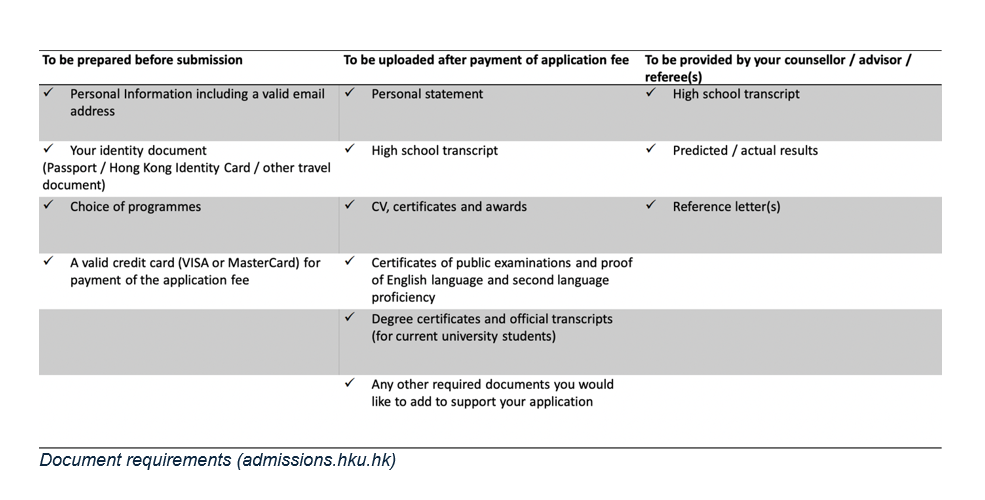
The documentation requirements are similar across universities, and not all documents are required at once. These requirements should be shared with students as soon as possible so that they can begin to gather the relevant documents and avoid delays further down the line.
The table below shows the requirements for the HKU application process and can be used as a benchmark for universities across Hong Kong. English translations of these documents should be provided, where relevant.
Application deadlines vary but the main round for HKU generally runs from 1 September to 1 December. Competitive courses might offer rolling admissions so encourage your students to submit their applications as soon as possible.
Students should apply as soon as possible to ensure they secure a visa in plenty of time, because they will require an offer letter before they begin the visa process (which can take more than six weeks). We will cover the visa process further later.
Interviews are increasingly being conducted online. They can be in a variety of formats, including group interviews.
Some universities, such as the Hong Kong University of Science and Technology, are now using dedicated interview platforms – without a person on the other end of the call – where candidates are required to answer a fixed set of questions.
Practical tip: University application platforms are designed to be relatively straightforward to use, but mistakes do happen. I recommend gathering students interested in applying to each university and guiding them through the process as a group, to avoid any misunderstandings.
Visa guidance
Once students have received an acceptance letter, they can begin the visa application process. To apply for a visa to study in Hong Kong, students need the following:
- Acceptance letter
- Passport
- Recent photo
- Proof of financial support (such as bank statements)
- Information about the local sponsor (often the university itself)
- If under 18, authorisation from parents that the sponsor can act as legal guardian.
Practical tip: The visa application process can be confusing for students and parents. I recommend hosting a workshop for parents of students considering university in Hong Kong, to align expectations early – and to avoid problems such as expired passports. Encourage students to take the lead because they will be dealing with documentation on their own soon enough.
Healthcare
Healthcare is not free in Hong Kong. You should advise students to secure medical insurance as soon as possible after admission because some universities will require this prior to enrolment.
Funding opportunities
A range of performance-based scholarships is available for students in Hong Kong, including international students.
For HKU, applicants are automatically considered for some scholarships, which can cover full tuition (and beyond) for exceptional students. While no application process is required for these scholarships, students should research specific universities ahead of time so that they know the potential support available. Information on these scholarships can be found here.
There are also numerous government scholarships, which vary by qualifying criteria and funding amounts. The Belt and Road scholarships offer financial support to exceptional students from Belt and Road countries such as Indonesia, Mongolia and Thailand. These also extend to postgraduate degrees. Additional information can be found here.
Practical tip: while the prospect of financial support and scholarships sounds great, applicants are often unsure where or when to begin applying. You should regularly signpost scholarship opportunities, with information on application deadlines and acceptance criteria.