Admissions tests for UK universities: all you need to know
The majority of UK university courses do not require additional admissions tests – but some competitive courses do, and planning for these will need to form part of students’ application strategy







The majority of UK university courses do not require additional admissions tests. Instead, offers are made on the basis of the student’s final secondary education results, personal statement, reference and, in the case of creative courses such as art, architecture and creative writing, a portfolio of work.
A minority of competitive courses do require further tests, however, and preparing to take these will need to form part of the student’s application strategy and inform the guidance of their counsellor.
What are UK university admissions tests, and which universities use them?
The main tests are as follows:
The University Clinical Aptitude Test (UCAT) is usually required for medicine and dentistry.
The Law National Aptitude Test (LNAT) is used by the universities of Bristol, Cambridge, Glasgow and Oxford, as well as Durham University, King’s College London, the London School of Economics, UCL and SOAS University of London.
Subject-specific tests are required by the University of Oxford, for students applying for classical archaeology and ancient history, biomedical sciences, classics, mathematics, modern languages, physics or philosophy. Students applying for politics, philosophy and economics; economics and management; experimental psychology; history and economics; human sciences; and psychology, philosophy and linguistics are required to take one or both sections of the Thinking Skills Assessment (TSA).
The Engineering and Sciences Admissions Test (ESAT) is used by the University of Cambridge, Imperial College and UCL for courses in natural sciences, physics, veterinary medicine and engineering.
The Test of Mathematics for University Admission (TMUA), for mathematics, economics and computer science courses, is used by Cambridge, Imperial, Warwick, LSE, Durham and UCL.
The Test of Academic Reasoning for Admissions (TARA) is required for a range of courses at UCL.
The ESAT, TMUA, and TARA are all set by the examination board UAT UK (University Admissions Tests UK), which is a collaboration between Imperial College and the University of Cambridge. The ESAT and TMUA were introduced in 2024 and the TARA will be used for the first time in 2025. It may be that additional universities adopt their use in the future. It should also be noted that the universities might vary in how the tests are used and the significance afforded them.
All tests are taken online at Pearson Vue testing centres. These can have limited capacity and students should book well in advance.
Why do universities test?
There are several reasons why universities would use the results of these tests to inform their offer-making:
- They allow differentiation between students achieving top grades.
- They allow comparison of disparate international qualifications.
- They allow universities to assess skills (as opposed to knowledge) relevant to the course applied for.
What is involved and when can the tests be taken?
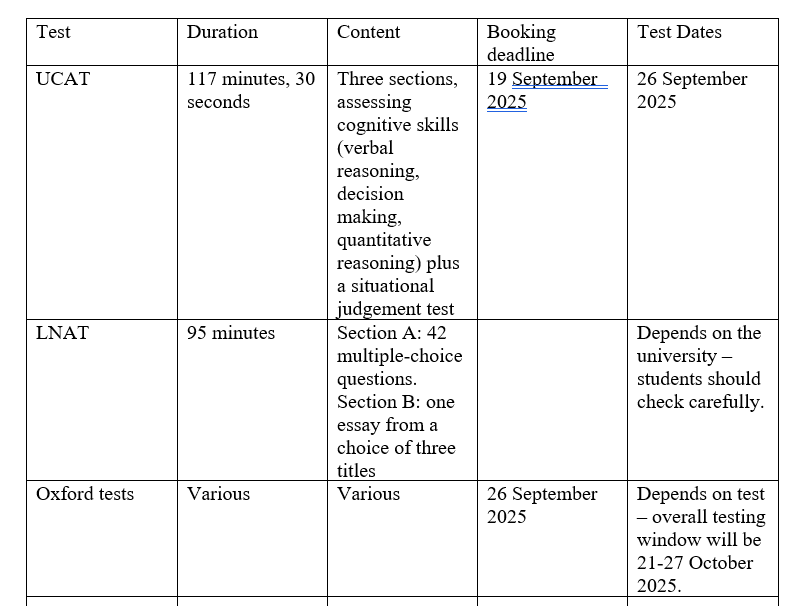
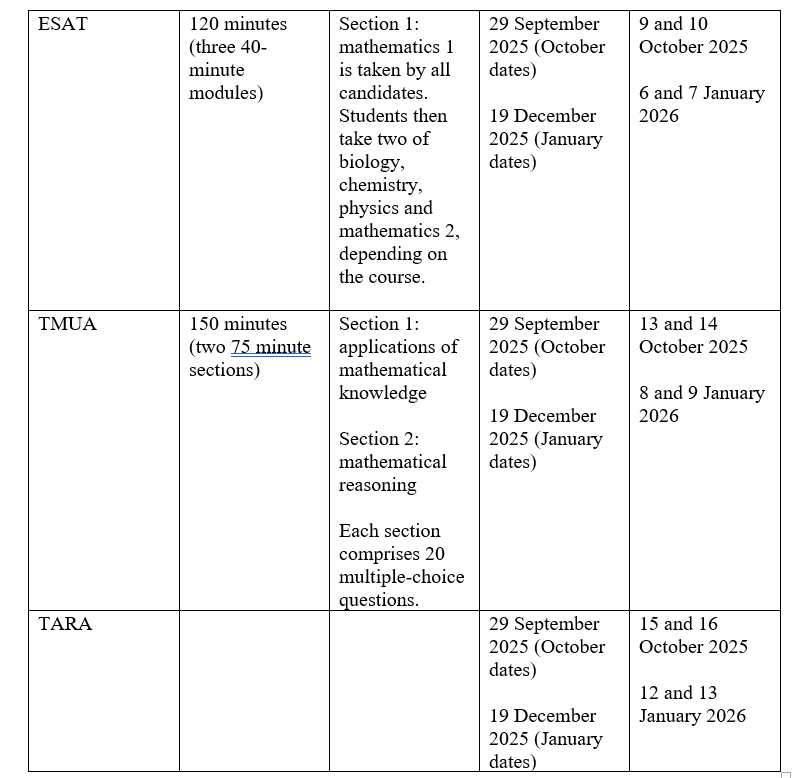
Students taking the ESAT, TMUA or TARA cannot take the tests twice. Cambridge applicants must take the October sitting.
Implications for counsellors
The growth in tests has implications for counsellors guiding students who are considering applying for these courses. Students will need to consider their application strategy, including the timeline for applications and the combination of universities to which they want to apply.
It could be a good idea to include a mixture of universities that use the test and those that do not, so that students are not reliant on their score.
Of the universities that test, students should look carefully at how the tests are used, and which test is used. Universities do not all use the same test for similar courses. For example, computer science at Oxford requires the Oxford Mathematics Admissions Test (MAT) but the same course at Imperial requires the TMUA, and at UCL the TARA. This is an extreme case, but students should consider which test plays to their strengths, how many tests they have time to prepare for, and what can be deduced about the ethos of the course from the test.
Students will need to decide quite far in advance where they are applying, in order to book and prepare for the tests. The tests often fall during a half-term or mock-exam period, which adds to the logistics the student and the school need to take into consideration.
You will also need to communicate clearly with students and parents about the tests, their nature and the timeline involved.
Students and parents are likely to have questions about support in preparing for the tests. There are plenty of practice materials online, which are freely available, and the universities concerned will stress that the tests focus on aptitude rather than knowledge. Several companies offer external tutoring for a fee – the value of this will be something for students to consider carefully.