
What should engineering education look like in the age of AI?


Created in partnership with
Created in partnership with
You may also like
Popular resources
I started out as an engineer because I wanted to build things. Of course I was interested in how things worked, but I also wanted to get my hands on them, experiment and see what I could create.
This approach has stayed with me throughout my career, and it’s something I worry we risk losing sight of as universities seek to work out what engineering education should look like in the age of artificial intelligence.
Our students can now ask AI to produce code, explain complex technical problems or suggest designs. Often the outcomes are impressive, but what happens when the answer’s wrong or if the student doesn’t really understand how a result was achieved?
- ‘Universities must manufacture the work experience AI is deleting’
- We promise our graduates will be employable. Are we keeping that promise?
- Instead of producing finished graduates, aim to build adaptable people
We still need to teach the fundamentals, but we also need to give students the experience and confidence to question what they’re being told, make their own decisions and, ultimately, take responsibility for the results. And you can’t teach all of that in a classroom.
What happens when things go wrong?
Some of the most useful lessons result from students grappling with a problem that doesn’t have an obvious answer.
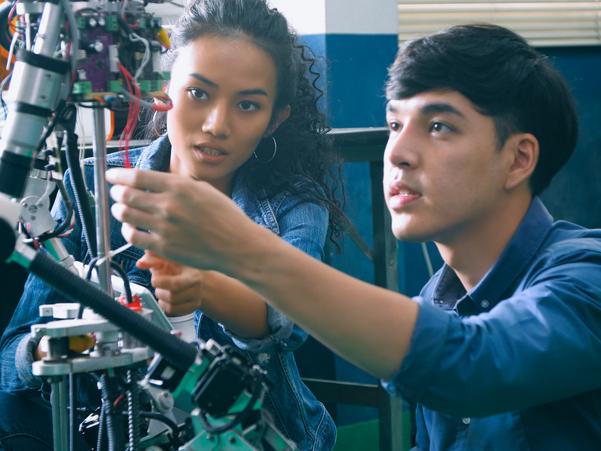
Consider a group of students preparing a robot for a competition. They’ve spent weeks designing and building it, testing components and making adjustments. Then, in front of the judges, something fails.
It’s frustrating and perhaps embarrassing, but it’s also an extraordinary learning opportunity.
Working as a team, they have to figure out the problem, decide how to respond and support one another. There might also be a deadline, a disagreement over the best solution or a component that simply refuses to work.
By comparison, an exam can test whether students understand a technical principle, but it’s much harder to recreate the challenges sparked by experience.
As well as teamwork and problem-solving, students need to learn how to communicate their thinking to someone who isn’t an engineer. An excellent technical solution means nothing if you can’t explain it to the client who’ll be paying for it or to the people whose lives it might impact.
Robots were never the whole story
Before joining my current institution in Morocco, I led robotics activities at the American University of the Middle East in Kuwait.
My students worked on some remarkable projects, developing an EEG-controlled prosthetic arm, which received an IEEE EmergiTech Best Paper Award in 2016. There was also a bionic arm, an underwater vehicle designed to monitor oil spills and, during the pandemic, a humanoid robot for Covid-19 screening.
But crucially, students had to learn things they hadn’t been taught, working with people who approached problems differently. Some ideas didn’t work, and they had to unravel why. They discovered what it meant to take ownership of something from the very first idea right through to a finished result.
I’ve often said that the real story isn’t about the robots we build. It’s about the students those robots build.
At my university, we’ve already got students involved in laboratories, undergraduate research, robotics, internships and competitions. I want to strengthen these opportunities and make sure that practical learning is part of what studying engineering means.
Here’s what I feel are the key takeaways from this:
1. Invite industry to bring a real problem
One area where universities can do more is in the way we approach and work with employers. Sometimes we overlook what might be the most valuable contribution an industry partner can make: bringing a real problem into the university.
A company might have a process it wants to improve, a technical difficulty it can’t resolve or an idea it wants to explore. Give students a chance to work on these challenges, with support from academic staff, and they learn things that are difficult to reproduce as a conventional assignment.
They will ask questions, learn what the client actually needs, and work within constraints they didn’t choose themselves. They also have to explain what they’ve done and why.
The employer gets fresh thinking and an opportunity to work with potential future recruits. Students get experience that means something beyond a mark on a transcript.
At my university, we are developing an industry capstone project service to make this kind of collaboration more systematic. Companies will be able to present problems for students and faculty to work on together.
It’s also important to avoid a common weakness in university-industry engagement: partnerships dependent on the personal relationships of just one or two academics. We need to give ideas a structure that can survive changes in staff or priorities. Someone has to take responsibility for maintaining the partnership.
2. What AI changes and what it doesn’t
The growing use of AI makes these practical experiences highly valuable. When a student can generate code or a technical explanation in seconds, simply producing the output tells us little about their understanding.
The important bit is how they reached a decision and whether they can explain the answer. Have they checked it; do they understand its limitations; and would they recognise if the tool makes a mistake? These are questions that I want students to become comfortable asking.
At our School of Science and Engineering, our intention is to integrate AI appropriately across teaching, with clear ethical standards and justified exceptions where its use isn’t suitable.
There’s another reason universities need to think beyond narrowly technical training.
Our engineering students study within an American liberal arts model. Alongside their specialist subjects, they develop communication, critical thinking and a wider understanding of society.
I see this as a strength. An engineer designs a system – but somebody has to use it, pay for it or live with the consequences if it goes wrong. The ability to think about these wider implications matters just as much when the technology involved is AI.
3. Don’t make practical learning optional
Some of the most valuable student projects start with modest resources, an enthusiastic academic team and a problem worth solving. The important thing is to make the experience count. Students need clear learning objectives and appropriate supervision, while employers need to understand what they are being asked to contribute.
At our school, we’re developing new facilities and initiatives, including a fabrication laboratory and expanded robotics activities, giving students more opportunities to design, test and build, and to work alongside industry partners.
But this is just a part of the answer. I’ve seen what a small group of motivated students can achieve when something doesn’t work, with the freedom to experiment and the support to keep going.
4. What should a graduate be able to do?
In higher education, we’re constantly talking about enrolment, assessment, research performance and graduate employment.
But we should ask a more basic question: what can our students actually do after they leave us?
Can they work with someone from a different discipline; deal with a problem that doesn’t have an obvious solution; or explain a decision to somebody who doesn’t possess their technical knowledge? And when something goes wrong, as it inevitably will, do they have the confidence and determination to work out what happens next?
AI will clearly continue to change the tools that engineers use, and some of the tasks we currently teach them to perform. What it won’t remove is the need for people who can understand the technology, question results and take responsibility for how it is used.
I still want our students to leave university with strong technical knowledge. But I also want them to have built something, struggled with a problem and discovered that they can solve issues they haven’t encountered before.
This is when engineering education really makes a difference.
Samer Al Kork is dean of the School of Science and Engineering at Al Akhawayn University.
If you would like advice and insight from academics and university staff delivered direct to your inbox each week, sign up for the Campus newsletter.
