
The Sisyphus trap: surviving plummeting funding success rates



You may also like
As an early career researcher, I quickly discovered that the traditional equation of effort yielding reward does not always apply to grant capture. You can spend months meticulously developing an idea, then invest more time to secure strong internal reviews and submit a highly competitive proposal, only to have it rejected.
I initially found this reality difficult to accept. I expected that deep investment and high-quality science came with a reasonable chance of success. While those factors make an application competitive, they cannot overcome the reality of the current funding climate. Recent figures highlight this strain. The number of grant applications assessed almost doubled over a seven-year period, according to UK Research and Innovation data published last year, while the overall award rate halved. Success rates for many standard and early career schemes now frequently hover between 15 and 20 per cent. A final decision often depends on how several excellent applications compare when panel budgets are severely limited.
During those early years, I was trying to establish a research direction, gain experience in the funding system and build career momentum. What I did not fully appreciate was how much vital research time was absorbed by applications with limited potential to contribute to my goals.
- Finding the funding: how to support research projects of any size
- How a five-year plan can help realise your research career goals
- How to get your research found on Google Scholar
As my research career has developed, my approach to funding has fundamentally changed. I have learned that building a research programme absolutely depends on winning grants, but it also requires deciding which opportunities are worth pursuing and understanding where finite time is best spent.
Escaping the Sisyphus trap
When an inbox fills with notifications that your funding application has been unsuccessful, grant writing can easily feel like the punishment of Sisyphus. According to Greek mythology, Sisyphus was condemned to roll an immense boulder up a steep hill for eternity, only to watch it roll back down to the start, yielding zero cumulative progress.
But, as researchers, we have the agency to ensure a rejected proposal does not leave us exactly where we started. It is up to us to turn the cycle of application and rejection into a process of continuous improvement.
A proposal can sharpen a complex research question, bring potential collaborators together, generate preliminary work or expose a critical gap in the literature. None of these outcomes guarantees a successful second application, but they inherently strengthen the research that follows. After a rejection, I still want to know why the proposal was not funded, but I also ask what we have built through the process that we can use now. Sometimes the answer is a stronger partnership, and sometimes it is a conscious decision to stop pursuing that particular idea altogether. That is highly useful information.
The hidden cost of the volume game
The defining lesson I took from these early experiences was that funding should support a research programme, rather than the research programme being continually reshaped around the next available call.
That distinction matters deeply when competition is intense. A call can look attractive simply because it offers a source of income, but the mere existence of a call does not make an application worthwhile. Preparing a competitive proposal requires weeks or months of intense focus. So, I ask a few simple questions to weigh the opportunity and its hidden cost. Could we make a genuinely competitive application? Would winning make a meaningful difference to the research programme? And is the required investment of time proportionate to what the funding could enable?
To bring this into focus, consider a simple thought experiment. Imagine two early career researchers applying for grants of the same size, requiring the same development time. Researcher A submits 10 applications and secures three funded projects. Researcher B submits only four applications and secures two.
From an institutional perspective focused purely on volume and overheads, Researcher A might appear to be the higher achiever. But for an early career researcher navigating a demanding transition, whose reality is more sustainable? Researcher A spent countless hours writing seven unfunded proposals. While a rejected application can be a valuable learning tool, submitting at such a high volume often forces a scattergun approach, leaving little time to reflect, adapt or build upon those lessons. Researcher B likely used that time to conduct research, publish, build new methodological skills or simply avoid burnout. Application volume is not the same as research progress.
The S-curve of an academic career
One way I make sense of how my own approach to funding has evolved is through an S-shaped view of my academic career (see below).
In the early, flatter part of the curve, progress can feel agonisingly slow, despite high effort. You are establishing a research identity, forging networks and building the confidence to decide where to focus. Much of this foundation work is cumulative, and its value becomes visible only later. This was the stage when I pursued funding most broadly, simply learning how different panels and calls operated.
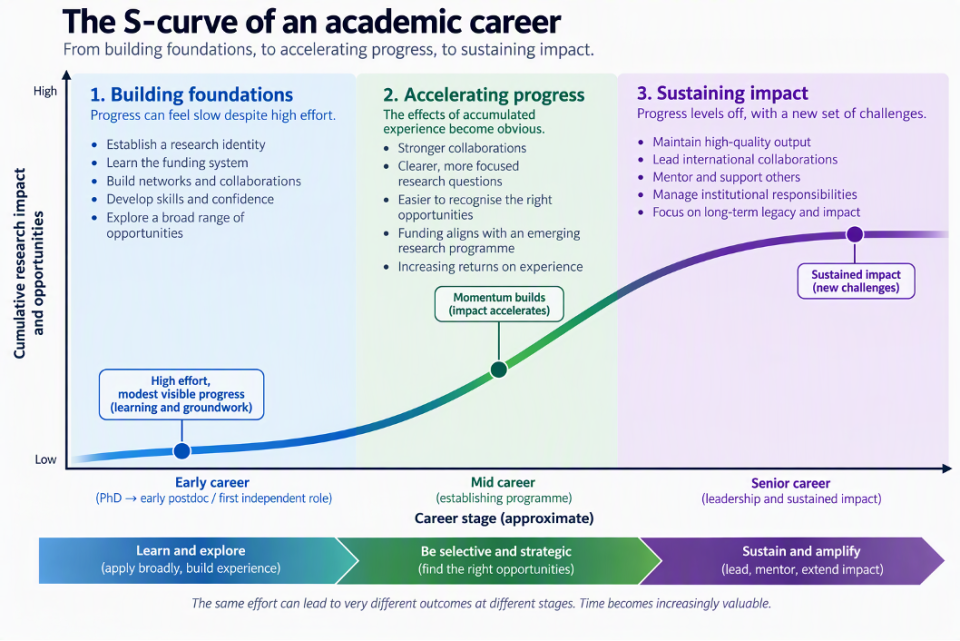
As the curve becomes steeper, the effects of accumulated experience become obvious. Stronger collaborations and clearer research questions reinforce one another, making it easier to recognise which opportunities fit and which do not. Funding becomes less about chasing any opportunity and more about finding the right opportunities to extend an emerging research programme. Later, as the curve flattens at the senior level, the challenge shifts to sustaining output, leading international collaborations and managing institutional responsibilities. At every stage, time becomes increasingly valuable.
I still spend substantial amounts of time on grant applications. Much of the work I have been involved in would not have been possible without successful funding. What has changed is that I no longer assume every call warrants an application.
For an early career researcher, this calculation is notoriously difficult. A specific fellowship may be vital for establishing independence, meaning an uncertain opportunity can still be worth pursuing. This does not mean junior researchers should simply apply less. Rather, it means being ruthlessly clear about what each application is intended to achieve.
Rejection will remain a permanent fixture of academic life. For me, the internal dialogue has gradually shifted from asking what I can apply for to asking what research I am trying to build and which funding opportunities will help move it forward. That change has made me more selective, but it has not made me less ambitious. To build a sustainable career, we must embrace a counterintuitive reality. In a highly competitive landscape, deciding not to apply for an unsuitable grant is not a missed opportunity. It is a strategic decision that preserves the vital time and mental bandwidth required for actual discovery. Ultimately, we must each ask ourselves a critical question: is success measured by the sheer volume of proposals we submit or by having the courage to walk away from calls that distract us from doing our best work?
Meysam Qadrdan is professor of energy networks and systems at Cardiff University.
Disclaimer: AI was used to develop the graphic included in this article.
If you would like advice and insight from academics and university staff delivered direct to your inbox each week, sign up for the Campus newsletter.
