
The Coming Digital Disruption: How Gen Alpha Will Reshape Higher Ed IT


Beyond affordability concerns or uncertainty about degree relevance, America’s next generation of students arrives with radically different assumptions about how technology should support learning. Born in 2010, the year of the iPad and Instagram, Gen Alpha grew up with AI in their pockets, video-led learning on demand, and near-instant access to information. They will enter higher education from 2028 onwards, and their expectations will make Gen Z look conservative.
For CIOs, CTOs, IT directors, and digital learning leaders, this is a transformational shift.
Why Gen Alpha will force a digital redesign
The report, From Gen Z to Gen Alpha: A New Era of Digital Expectations, surveyed 530 U.S. teens aged 13–15 and drew on data from an additional 3,394 respondents. Their answers reveal a cohort that expects technology not just to support learning, but to drive it.
Key findings with direct implications for IT and digital strategy:
- AI is already embedded in how they learn
• 73% use or plan to use AI tools; 2 in 5 already rely on ChatGPT to study.
• They’re not coming to campus expecting AI to be integrated into every workflow.
• 54% can code or would like to learn, and ¼ are self-taught
Implication: Universities need an AI strategy that addresses policies, tools, integrations, ethics, cybersecurity, and faculty enablement.
- They are mobile-first
• 85% own a phone; 52% use it for homework.
• Social, academic, and organisational tasks all converge on one device.
Implication: Legacy web portals and desktop-first systems won’t cut it. Every student-facing layer must be designed for seamless mobile performance.
- Hybrid is their default learning environment
• 56% prefer hybrid learning, 30% remote, only 14% fully in-person.
• They expect a seamless integration of online and offline
Implication: Hybrid must be supported by design: network density, device access, remote software access, recording tools, digital submission workflows, and consistent experiences across modalities.
- Edtech saturation
• 93% already use at least one educational app.
• Half use Chrome devices; many rely on limited hardware.
Implication: Universities must support a heterogeneous device environment—Windows, macOS, ChromeOS, iOS—without compromising access to specialised software.
- High device expectations
• 96% expect their college to provide devices to borrow, own, or access on campus.
Implication: Device loan programmes, virtual labs, and cloud-first delivery models will need to scale.
- Low patience for poor performance
Across digital experiences, students care most about:
• speed (64%)
• ease of navigation and seamless interactions (61%)
• relevant content (56%)
Implication: Every millisecond counts. IT must tackle fragmentation, slow authentication, unpredictable lab performance, and legacy systems that frustrate students. Their perception of value is closely linked to this.
- Ongoing wellbeing and equity concerns
Implication: Digital wellbeing, privacy transparency, cybersecurity and equitable access models cannot be afterthoughts. Guidance and education are paramount.
What this means for university IT and digital strategy
Gen Alpha’s expectations point toward one core reality: the student digital experience will increasingly define the institutional experience. It's clear that students expectations of higher education are to provide the tools and environments that will help them to succeed.
To prepare, IT leaders should focus on several priority areas:
- Deliver true mobile-first services
Make every high-impact student interaction—registration, timetabling, support, learning tools—fast, responsive, and mobile-native.
- Build a stronger BYOD and device-equity model
Support a wider range of devices (especially ChromeOS), stronger loan programs, and robust campus Wi-Fi capable of handling thousands of concurrent, video-heavy connections.
- Scale hybrid learning infrastructure
This means virtual labs, cloud software delivery, lecture capture, consistent remote access, and scalable application streaming—so students can work anywhere.
- Operationalise AI
Integrate AI tools into LMS platforms and academic workflows, supported by clear governance, cybersecurity frameworks, and faculty training. Protect data and IP from AI training.
- Support self-directed learning
Centralise access to safe, approved educational apps; encourage experimentation; reduce friction to access.
- Modernise LMS and submission platforms
Reliability, uptime, and speed are non-negotiables. Students expect a single pane of glass, not a patchwork of siloed systems.
- Embed wellbeing and digital literacy
Incorporate privacy guidance, screen-time awareness, and digital support into the student journey.
For IT leaders, the question is no longer whether to transform. It’s whether the transformation underway is fast and comprehensive enough to meet the expectations of the first AI-native generation.
Why it matters
Gen Alpha is optimistic about college, but only if higher education can match the fluid, personalised, mobile, AI-enhanced digital world they already live in. For institutions, this is a moment of urgency and opportunity: those who modernise now will stand out to a generation that is extremely discerning about digital quality.
These findings prompt essential strategic questions for university technology teams:
- Is your current digital transformation bold enough?
- Are your platforms designed for AI-native students?
- Are your systems built for high performance on any device, anywhere?
- Will your infrastructure support the next decade of learning models?
- How prepared are you for Generation Alpha?
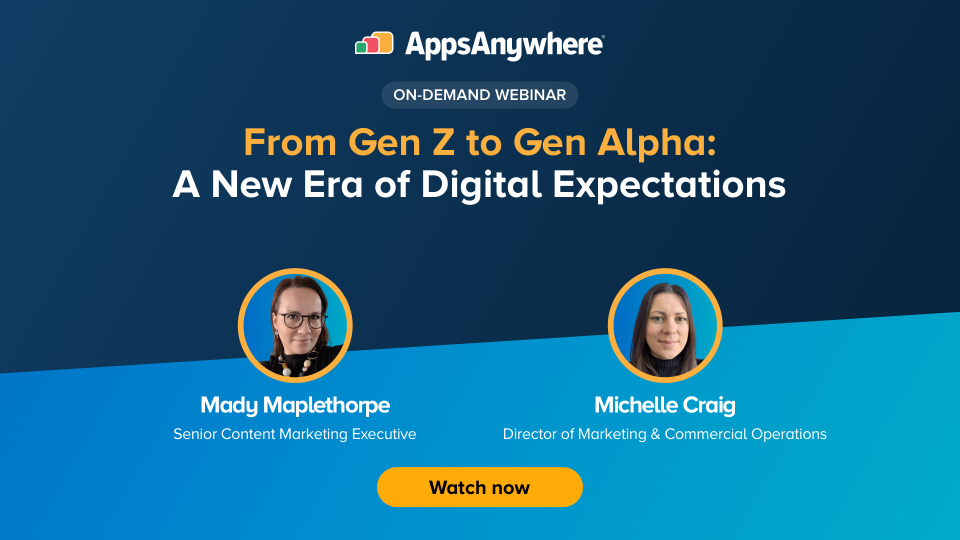
Learn more at in this webinar
To explore the full research, its implications, and practical steps for IT leaders, watch the “Gen Z to Gen Alpha: A New Era of Digital Expectations” webinar, where we unpack the findings, discuss emerging digital experience priorities, and share strategies universities can implement now to prepare for Gen Alpha.
Register here to watch it on demand.
