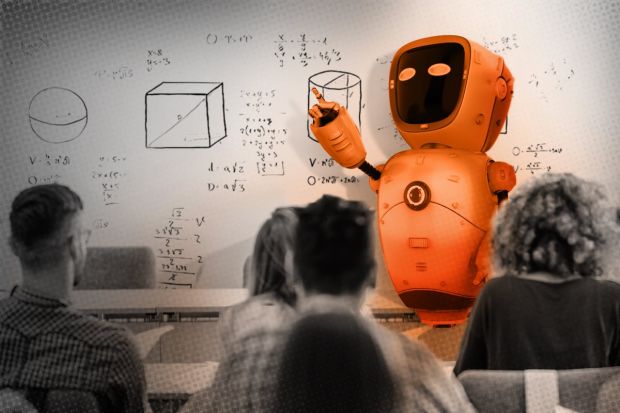
Despite early evidence that the use of artificial intelligence can negatively affect learning outcomes, the pressure on universities to adopt AI tools keeps growing. According to some economists, universities must train students to use AI in order to prepare them for the AI-changing labour market.
Some go further, insisting that universities are actively harming students by teaching them “counterproductive” skills. On this view, clinging to conventional educational standards is not cautionary but negligent.
The remedy, we are told, is an inevitable and comprehensive technological transformation of the university to meet the demands of the emerging AI economy.
But this argument is suspect, even on its own terms.
To start, it presupposes a narrow view of what higher education is for. Students are not only future employees; they are also citizens, voters and, more generally, moral agents. Although work remains an important form of participation in society, it is clearly not the only one. An education that merely trains people for the job market may equip them for one part of life, but it neglects those parts of life that demand sound moral judgement and independent thought.
The case for cultivating critical thinking, intellectual autonomy and civic and moral virtues does not weaken with AI-driven shifts in the labour market, because these valuable capacities and skills have never been justified by their financial pay-off in the first place.
Therefore, before adopting AI wholesale, universities need firm evidence of how its use affects learning, judgement and independence, and so far, the evidence of its negative effects keeps mounting.
But the labour market case for an AI-driven overhaul of universities fails on its own terms.
The future of AI at workplaces is deeply uncertain. Two technology-related trends are unfolding in parallel: AI is enhancing some existing human labour while at the same time eliminating other forms.
Which trend will dominate the labour market is difficult to predict. As The Future of Jobs Report 2025 by the World Economic Forum warns, without appropriate regulation and incentives, AI development may tilt towards replacing rather than enhancing human labour. We are already witnessing a reduction in entry-level hirings. Even if the current rate of automation is very low, the line between the enhancing and eliminating effects of AI is unstable. What is enhancing today could become eliminating tomorrow.
It makes little sense for universities to fundamentally reorganise themselves in order to teach students how to work alongside AI if the AI industry is aiming at the automation of much of this work entirely.
When no one can say which AI skills the labour market will reward in five years, the strategy should be to invest in enhancing durable capacities rather than short-lived and tool-specific ones.
This becomes even clearer once we ask what “AI skills” even mean. Proponents tend to appeal to AI’s “potentiality” without specifying its educational content. If AI skills refer to the ability to assess AI-generated content then they presuppose, rather than replace, the higher-order skills, including critical reasoning and independent thought that universities are already tasked to teach.
We cannot expect future workers to critically assess AI-generated content without first acquiring knowledge and skills of their own. If, on the other hand, AI skills mean proficiency with particular types of AI tools, universities are not the right institutions to provide such context-specific vocational training.
Employers know their practical needs better than universities do, and are better placed to train employees in the use of specific AI tools and systems that their day-to-day operations require, especially given that currently many entry-level roles require only modest adjustments.
Interestingly, employers also express concerns over students’ lack of essential communication and interpersonal skills, resilience and self-awareness. This suggests that universities should double down on teaching students human skills that cannot be easily automated, instead of teaching skills that may hold value only for a year or two.
Even champions of the AI transformation of higher education acknowledge this.
None of this means that universities are required to keep AI outside their walls. Students need opportunities to experiment with AI responsibly: to test its usefulness, question its outputs and discover its limitations.
However, AI literacy cannot be limited to acquiring narrow technical skills. Because the dominant AI tools are designed by particular economic actors and for specific (typically commercial) purposes, students should also learn how these systems are trained, when and why they fail, how they may reproduce bias and misinformation, how they affect privacy, how their use impacts the environment and how their increasing adoption is reshaping workplaces.
They also need to understand what AI-enhanced work can mean in practice: employees’ continuous surveillance and data collection (such as Meta’s Model Capability Initiative), heavier workload and “AI brain fry”, the erosion of autonomy and a sense of achievement and an increasing sense of the pointlessness of one’s own work.
This is what the job market argument overlooks by taking the AI transformation of work for granted.
Once AI literacy is understood in this broader sense, it becomes clear that integrating AI into higher education does not warrant its overhaul, let alone embedding AI indiscriminately across the curriculum.
For at least some disciplines, dedicated courses in critical AI literacy would suffice. To claim otherwise is to confuse the central goals of education with the teaching of narrow, context- specific and very likely short-lived AI-related skills, which would shift the cost of corporate training on to students and public institutions.
This points to a larger, burning political question that universities cannot avoid: who gets to define the future for which students are being prepared? The pressure to transform higher education in line with an AI-captured labour market is not coming from neutral sources. When OpenAI’s vice-president of education tells universities what their purpose should be and what they should teach their students, we need to hit pause. Corporate leaders have no obvious standing to decide what universities are for, nor what teachers and students should do in their classrooms.
Do we really want to support the further corporatisation of universities and their ever-increasing dependence on privately owned tools often aimed at commercial or even militaristic ends?
On reflection, our answer is clear: the authority to decide what universities are for must remain with students and educators, policymakers and civil society at large. Otherwise, universities will stop preparing students to shape the future and start training them to merely endure it.
Jelena Belic is assistant professor of political philosophy at Leiden University and Kritika Maheshwari is assistant professor of ethics and philosophy of technology at TU Delft. The authors declare no use of AI at any stage of research and writing.
Register to continue
Why register?
- Registration is free and only takes a moment
- Once registered, you can read 3 articles a month
- Sign up for our newsletter
Subscribe
Or subscribe for unlimited access to:
- Unlimited access to news, views, insights & reviews
- Digital editions
- Digital access to THE’s university and college rankings analysis
Already registered or a current subscriber?