
Training tomorrow’s citizen scientists in introductory science courses


Created in partnership with

Created in partnership with
You may also like
Popular resources
On the morning of 29 September 2024, an enormous cloud of noxious gases woke residents of Conyers, Georgia. Few, if any, of the residents of the small city just east of Atlanta were professional chemists, but over the next two weeks they all had to become chemists in order to respond to the degraded air quality near their homes, which had been caused by a fire at a pool-chemical plant.
The Environmental Protection Agency initiated a campaign of monitoring, remediation and education that lasted months and engaged the surrounding community. But I would wager that, despite the immediate environmental crisis, most locals didn’t look back on their past chemistry classes for answers, if indeed they had ever taken one.
To me, as a college professor who teaches general chemistry to hundreds of undergraduate students every semester, that’s a disappointing thought. Even if an education in chemistry doesn’t lead to a chemical career, shouldn’t it at least equip learners with the tools to become a citizen chemist when they need to be?
- How living labs bridge the gap between the classroom and the real world
- Harness the power of ‘what if?’ in STEM teaching
- Spotlight guide: How to be an even better teacher
I’ve been around long enough to experience multiple teaching ruts in multiple divisions of chemistry (general and organic). Although helping students remained fulfilling, I found myself wondering if I was teaching students the right things. Aside from the “meat” of chemical theories and models, what are students really learning in my large chemical principles courses? Are they walking away with the confidence to negotiate chemistry in their careers? What about in their everyday lives? Are they getting the message that big ideas are more important than the nitty-gritty details?
I didn’t like my own answers to those questions.
So, I started infusing demonstrations, case studies and current research into my courses. These reminded me to show students that they can find chemistry all around them, if only they remember to look. In shifting my focus to training the citizen scientists of tomorrow, I’ve found a guiding light for my teaching.
Here’s why these interventions help stave off complacency and burnout.
Demonstrations make chemistry visible
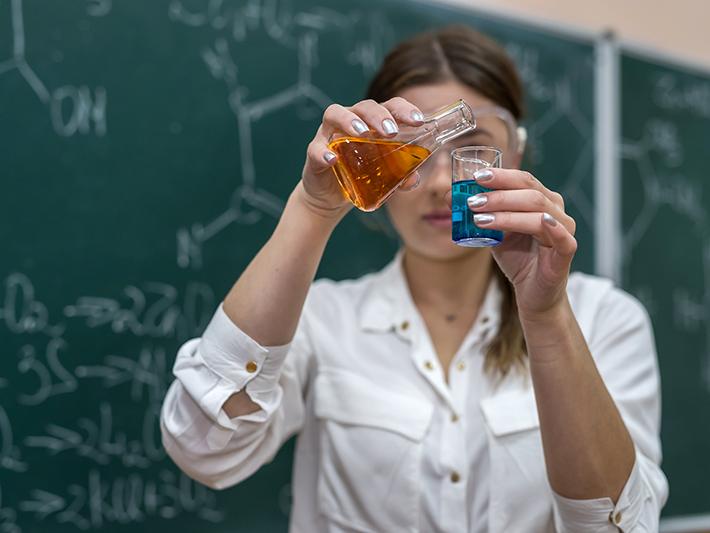
Chemical demonstrations have an element of showmanship that reliably recharges my teaching batteries. They highlight the dazzling and sometimes unexpected ways chemistry manifests itself, and are a great motivational tool.
Students feel the difference in density between lithium nitrate and lead(II) nitrate in a unit on representing ionic compounds. In the thermodynamics unit, we observe the conversion of work into heat with a fire piston, learn how a temperature difference is converted to work by a Stirling engine, and introduce the second law and the “arrow of time” with a bogus demonstration. Before digging into the theory of electrochemistry, we observe how easy it is to create a working battery using a lemon and two coins.
Case studies put chemistry in the real world
I am also energised whenever chemistry appears in the news and I spot an opportunity to show students how the concepts and models they’re learning intersect with current events.
For example, I used the chemical-plant fire as the basis for an entire midterm exam in my Chemical Principles II course. A seemingly endless parade of small molecules in news and media has provided fertile ground for introducing molecular structure; vinyl chloride, ivermectin and apremilast are a few I’ve used in recent years.
While these appearances don’t typically shine a positive light on the compounds themselves, my hope is that students learn they can apply analytical tools to negative situations and in so doing gain some measure of equanimity.
Current research makes chemistry dynamic
The pace of scientific research is faster than ever. Exciting findings hit the pages of chemistry journals almost daily. I follow a few major chemistry journals – not so many that it feels like a chore but enough to pique my curiosity – and enjoy using primary literature articles as a basis for problems grounded in real science. This not only helps me avoid burnout but also helps students connect what they’re learning to up-to-date research. Sometimes, the research comes from educationally focused journals such as the Journal of Chemical Education or Chemistry Education Research and Practice, although just as often I pull articles from the Journal of the American Chemical Society, Nature or Science.
Wherever our students end up in their careers or lives, we all want them to see our subject around them and to be able to approach it rationally. The drive to create citizen scientists is an evergreen motivation for teaching that can help faculty escape from even the deepest pits of teaching burnout.
For STEM faculty, demonstrations, current events and recent research can connect technical ideas to everyday life. The next time you find yourself in a teaching funk, try looking for your field in the world around you. It’s probably easier to find than you think.
Michael Evans is a principal academic professional at Georgia Institute of Technology.
If you would like advice and insight from academics and university staff delivered direct to your inbox each week, sign up for the Campus newsletter.
